
PETA and Porn: Exploit Women, Not Animals
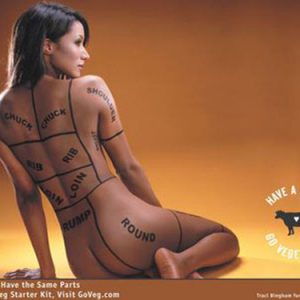
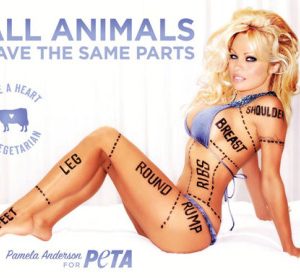
PETA ad featuring Pamela Anderson that was banned by the city of Montreal in 2010 for being sexist.

PETA ad featuring Pamela Anderson that was banned by the city of Montreal in 2010 for being sexist.

By Ashley-Michelle Papon

Just in time for the chill of the holidays, the marketing wizards at People for the Ethical Treatment of Animals (PETA) have come up with a new way to keep converts to animal welfarism warm. Within the next month, PETA will capitalize on their previously raunchy skin campaigns with a companion porn site. The porn site, PETA.XXX, will showcase plenty of celebrities willing to bare all, but according to Lindsay Rajt, PETA’s associate director of campaigns, the site will also feature displays of what PETA considers animal abuse. “We’re hoping to reach a whole new audience of people, some of whom will be shocked by graphic images that maybe they didn’t anticipate seeing when they went to the PETA triple-X site,” Rajt said.

From billboards preying on insecurities about swimsuit season as a method of somehow saving whales to advertisements suggesting your real concern during airport body scans should be how hot your vegetarian body looks, the idea that PETA could still manage to shock anyone is worthy of a laugh. Or two. Though the artwork from ad to ad differs, the message is overwhelmingly the same: learn to respect the welfare of animals, while disrespecting that of people.

In other words, a porn site featuring juxtapositions of animal abuse images isn’t a new low; it’s exactly the type of half-baked tasteless trafficking that we should be expecting from PETA. As a countless number of galleries–including this one by Time magazine–highlight, PETA’s co-founder Ingrid Newkirk long ago made the conscientious choice that the best way to sell her message would be through exploiting women, and she does it because it works, sticking to her philosophy that PETA is obligated to serve as “press sluts” to bring attention to their cause.

And stick to it, she does. Newkirk is, after all, the same woman who famously wrote to Yasser Arafat, urging him to keep animals out of conflicts with Israel after a donkey died during a suicide bombing. No such request for the then-prime minister to condemn “honor killings” such as bride burning and female infanticide, which accounted for a full two-thirds of all killings within Palestine territories at the time, reflecting PETA’s less charitable view of women’s expendability in general.

Not to mention PETA’s emphasis that a woman’s value is strictly in how her body looks. Fat-phobia has been PETA’s old trusty in the arsenal long before the “Save the Whales” campaign. Ideally, PETA shouldn’t care what a body looks like, provided that the body is simply sustained by a vegetarian diet and vegan living. In actuality, they know that if there is anything our patriarchal society reviles more than women in general, it’s women of size, and preying on those cultural prejudices has been a source of great media attention, which normalizes the violence visited on those same bodies.

Of course, this cavalier dismissal of violence against humans (specifically, women) is the real problem with PETA’s approach to activism. In 2002, PETA filmed a would-be Super Bowl commercial, which depicted a group of hooligans beating a woman to death with a baseball bat to the caption of, “What if you were killed for your coat?” Though the commercial was banned from airing, just last year PETA turned up the heat (and the fake blood) to launch their “Meat is Murder” basics, placing humans in life-sized deli counter meat packages and cellophane. The gag might have been somewhat educational, if the models hadn’t looked as though they’d just come out of Jeffrey Dahmer’s freezer.

That joke might seem to be in bad taste (no pun intended) until you consider that the serial killer’s cannibalism has been the fodder of more than one advertisement and celebrity-targeted criticism. No, seriously. But Dahmer’s crimes aren’t the only ones that PETA finds acceptable to dovetail into their agenda. In 2008, PETA created an ad identical to their 1991 Dahmer special in response to the Manitoba Greyhound bus beheading, asking people to imagine the terror of victim Tim McLean and use it as motivation to “leave violence off of their dinner plates.”

However, the argument here isn’t that the decision to launch a porn website is continuing PETA’s legacy of playing up violence to make a point. Although feminists often disagree as to how empowering or violent pornography inherently is, what makes this particular venture par for the course is PETA’s decision to include images of animal torture. It’s a veritable buffet of -isms for the organization, with the unintended consequence of eroticizing the torture of animals.

Part of what makes PETA’s performance so frustrating is that they should know better. Their website contains a lengthy explanation about the correlation between people who abuse animals and violent behavior towards other human beings, suggesting that on some level, somebody in that organization should understand the intersectionality of subjugation for women and the animal kingdom.

More to the point, promoting misogyny—often, violent—with the end result of animal liberation makes about as much sense as using racism to end class politics. You’ll capture some headlines, but you’ll probably alienate more people than you galvanize, especially since people likely to be more sympathetic to animal causes tend to also be against the idea of exploiting women.

It goes without saying that there are plenty of reasons to care about the treatment of animals in this country and elsewhere. Any enlightened, progressive individual has to acknowledge that our experience is largely shaped by what we consume, and that includes consuming the animal community. But responsibility goes both ways, especially when we’re talking about oppression of marginalized classes like animals. For real change to happen, PETA has got to stop objectifying women to nothing more than literal pieces of meat.

* * *

Read other Adios Barbie content related to the eroticized violence of women:

A Monster Success! (reports on our successful petition against the official release of Kanye West’s misogynistic “Monster” video)

Deconstructing Kanye’s “Monster”


Post to Twitter

Marie Claire’s “Love Your Body Issue” is a Big Fail

howoldwomen

By Elena Rossini

A couple of weeks ago I read that the November 2011 issue of Marie Claire South Africa featured several thought-provoking ad campaigns by major advertising agencies on the topic of “Love Your Body.” I thought it would be wonderful to showcase this in my documentary “The Illusionists.” Thanks to the fabulous Jill Greenberg, who’s a Facebook fan of the project based in South Africa, this past Saturday I received a copy of the special issue in the mail. And I have to say, I was in for a BIG surprise.

A more accurate title for this issue should have been: “Please hate your body and buy our advertisers’ products.” Yes, it’s that bad.

The person chosen for the cover of the special “Love Your Body Issue” is statuesque supermodel Candice Swanepoel, wearing a bikini.

To her left, you can see the following headlines:

  • 21 DAYS TO GET BIKINI READY
  • TSELANE TAMBO ON LIFE AFTER LIPO
  • WIN: FREEZE YOUR FAT OFF!

And finally, in huge bold letters: Special Issue. LOVE YOUR BODY. 6 TOP SA AD AGENCIES COMPETE TO SHOW YOU HOW.

The first thing that one notices while turning the pages of the magazine is that it looks just like any other issue of a major fashion magazine, full of ads for cosmetics and luxury brands, and showcasing young, extremely thin models – whose pictures are thoroughly airbrushed, even in “candid” photos.

Like this one for instance:

The models’ legs have a plastic quality. They look like Barbie dolls.

After 40-something pages of advertising and galleries showing the latest beauty products and fashion accessories, the special “Love Your Body” section debuts, with various thought-provoking ad campaigns by South Africa’s top ad agencies.

TBWA shows the painting of Botticelli’s Birth of Venus. Underneath it, the headline: “Why change a masterpiece, you’re beautiful the way you are.

Next, an ad by Saatchi and Saatchi, showing the corpse of an older woman on a metal table. The headline: “When will you stop worrying about your appearance? Love the body you live in.”

Case in point:

Left: the ad by Canvas Lifestyle, showing a Barbie doll with several markings on her body. “Add cellulite from favorite heavenly chocolate brownies” … “Add caesarian scar from your first-born son” … “Add laugh lines from girls’ night out” …

Right: An ad for the Burberry fragrance “BODY” with a model who looks like a real life Barbie doll. Which is kind of contradictory, no?

Next ad:

Left: a simple message by TBWA. “IMPERFECT. I’M PERFECT. Start seeing things the way you really are.

Right: an ad for the Dolce & Gabbana fragrance “Light Blue” – with flawless looking models whose bodies are thoroughly airbrushed.

Next:

Left: a collage of photos by Kristina Stojilokovic that says, “Which part of your body would the people who love you change?” with close-up images of women’s bodies: a woman’s freckles, a big scar, knees, a belly button, a mole.

Right: an ad for L’Oréal Revitalift. With the big headline “FIGHT THE 10 SIGNS OF AGEING, IN A SINGLE GESTURE.

Less wrinkles
Smoother skin
Firmer skin
Rehydrated skin
More flexible skin
Suppler skin
Even skin tone
Radiant skin
Refined pores
Defined facial countours

The rest of the magazine doesn’t fare so well.

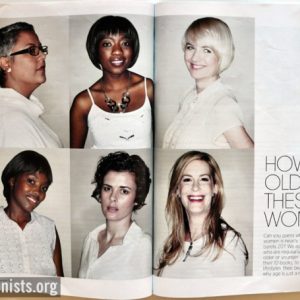
There are articles like: “I GREW HAIR ON MY CHIN” – “LIFE AFTER LIPO” and “HOW OLD ARE THESE WOMEN?” which asks readers to guess the ages of six women.

Then: “4 Ways to Get Beach Body” Ready

The final verdict: I would give this special issue a “FAIL” grade – on all fronts. The only diversity it showcases is racial: thankfully there are many African models represented. Problem is: they all have the same age and body type. ALL OF THEM. Every photo is thoroughly airbrushed, giving women a plastic / Barbie-doll-like quality. Including most of the “love your body” ads. This issue is the equivalent of the Big Bad Wolf disguised as Little Red Riding Hood’s grandmother. And this is quite sad, considering the opportunity Marie Claire had to promote positive body image.

To read more on the topic, check out my April 2010 review of Marie Claire France: “100% Without Airbrushing.

Originally published at The Illusionists. Cross-posted with permission.

Post to Twitter

When Did My Tampon Become a Fortune Cookie?

Fortune Cookie Tampons

By Sayantani DasGupta

Apparently, when I wasn’t looking, some corporate geniuses decided that tampons should come packaged with perky self-help style advice. I can see the business meeting now: “Hey, I know what a menstruating girl or woman might need at ‘that time of the month’ alongside product absorbency! How about some inspiration!”

And so, this morning’s plastic tampon wrapper (I know, I know, I should be using a non-plastic brand, or a diva cup but go with me here) nearly shouted at me with the rah-rah force of a pom-pom wielding cheerleader:

“Don’t Stress!” “Play to Win!” and, worst of all, “You’re a take-charge kind of girl!” it shrieked.

I don’t know about you, but I’m willing to take pseudo-Eastern sounding mysticism from the tag of my tea bag, but I draw the line at inspiring tampon covers.

So, I guess my real question is this: When did girl power go amok?

I just came back from the National Women’s Studies Association conference, where there were lots of interesting panels on girl’s movements and girlhood related politics. Some panel names were:

  • Hey Shorty! Young Women of Color Take Research Out of the Academy
  • The Sexualization of Girls Across Time, Space and Cultural Mediums
  • Today, Not Someday When We’re Grown: How Girls ‘Do’ Activism
  • Representing Girlhood and Girls of Color, From Hip-Hop to Health

Awesome, right? (I wish I could have attended them all!)

Girl’s activism is a real and formidable force in the U.S. and around the world. But in broader culture, “girl power” has become heavily usurped–a snazzy marketing ploy by corporate forces who want to appeal to women and girl’s pocketbooks, not our politics. I know there’s been a lot of attention to steering women and girls away from passive “pink” marketing like books from Packaging Girlhood: Rescuing Our Daughters from Marketers Schemes to Cinderella Ate My Daughter: Dispatches from the Front Lines of New Girlie-Girl Culture. But what about the taking over of “girl power” for marketing ends?

Consider the controversial Gardasil “One Less” commercials, featuring seemingly empowered, soccer playing girls also choosing to get vaccinated against HPV. (So… all girls who are empowered will get the HPV vaccine? Or alternately, get the HPV vaccine and become empowered?) Or, how about the Dove Clinical Protection deodorant ads in which a young woman cuts her own bangs with nail scissors (ooh, rebellious!) before deciding she will “Carpe Diem” today. Or, even the “Be Unstoppable” ads for Playtex Sports Tampons, which seem to shout (at least in my head), “Wear our tampons! Become a champion surfer!”

As opposed to the “F” word (feminism), which involves real-live grown-up women with real-live grown-up political agendas, “girl power” somehow goes down easier in mainstream culture. Girl’s activism becomes somehow read as feminism “lite.” Girls–even bang-cutting, soccer-playing, surfing girls–are cute and perky, right? Not bra-burning, hair-on-legs, speaking-their-minds or, erm, any other formulation of ADULT women?

I find that attitude pretty problematic–both for what it says about girls and girls’ activism, and for how it separates girls’ and women’s political actions and our common goals. (Not to mention how problematic it is to wake up one unsuspecting morning and find my tampon calling me, an adult woman with growing children of my own, a girl.) 

So marketers, lay off using girl power to support sales of your products. We don’t need your deodorant to be rebellious, or your tampons to help us win the big game. We just need them to do what they’re supposed to, and the rest we’ll manage on our own, thank you very much.

Girls’ activism, like women’s activism, is feminist activism, people. Girls’ bodies are not cutesy marketing tools, or a way to get girls and women to buy more junk we don’t need.

How about you keep your plucky advice on tea bags and in fortune cookies, and out of our bodies?


Post to Twitter

Remembering Ruby

ruby body shop

By Sharon Haywood

Fifty-something-old Barbie[1] might be middle-aged but she sure doesn’t show it. When she was in her 30s, her manufacturer Mattel sent her for plastic surgery, not to maintain her youthful appearance, but rather in response to market demands to morph her into a more realistic-looking doll. In 1992, Barbie’s waistline slightly expanded. Then in 1998, Mattel altered one version of the doll—Really Rad Barbie—giving her a decreased cup size and slimmer hips. Currently, her estimated measurements—38-18-34—contrast greatly with the American woman’s average of 41-34-43[2]. Barbie’s curves fall several inches short of what typical women possess today.

Considering that the average woman in the U.S. is a size 12/14, a doll that wears a double-digit dress size would be a much more accurate reflection of American women. The late Anita Roddick (1942-2007), the founder of The Body Shop, thought the same. In 1997, the socially-conscious international cosmetics franchise and Host Universal created Ruby: a chubby-cheeked, chestnut-haired, computer-generated figurine. Ruby was the brainchild of The Body Shop’s self-esteem campaign, “Love Your Body.” Her size 16 image was accompanied by the caption, “There are 3 billion women who don’t look like supermodels and only 8 who do.” She sent the message that you should love what you’ve got, not loathe it.

If you’re familiar with Ruby, you know that she’s not easy to locate. So, where’s this confident and curvaceous character been hiding? You can find her here, alongside other rejected and banned ads.[3] We can thank Mattel for Ruby’s label of “Banned.” The U.S. toy manufacturer thwarted the innovative campaign in its early days by serving The Body Shop with a cease-and-desist order; all posters had to be removed from American shops. Why? In Roddick’s own words:

“Ruby was making Barbie look bad, presumably by mocking the plastic twig-like bestseller … Mattel thought that Ruby was insulting to Barbie.”

Outside of Roddick’s explanation on her website, no other information regarding Mattel’s specific legal grounds can be found online. We can surmise that Ruby’s rolls and less-than-perky breasts were the offending culprits.

This year Ruby would have turned 14. But imagine if she had grown from being a self-esteem campaigner into a three-dimensional doll in direct competition with Barbie. Do you think that when she would have reached her 30s, she would have gone under the knife, too? Would the folks at The Body Shop have decided she needed a tummy tuck, a breast lift, and some lipo to give her a competitive edge? The Body Shop’s global communications head told the New York Times that Ruby represented “a reality check” in contrast to the “stereotypical notions of unattainable ideals.” Odds would tell us that the Rubenesque beauty wouldn’t have any part of her body nipped or tucked; in fact, like many women approaching middle-age, she might even have gained a couple of pounds. Regrettably, we’ll never know for sure.

Although Ruby’s existence was short-lived, her presence generated controversy. She caused Mattel to sit up and take notice. Along similar lines, consider that Barbie underwent cosmetic surgery to appease consumers’ demands. Although Mattel was conservative in its alterations of Barbie’s figure, the company did respond to the public. Furthermore, with sales of the blonde figurine consistently dropping,[4] the toy manufacturer has even more incentive to cater to the customer. If more and more women let corporate giants like Mattel know what they really want, who’s to say that Barbie’s waistline (and the rest of her) can’t fill out as she eases into her fifties? Something to ponder in memory of both Ruby and the visionary Roddick.

Originally published at Any-Body on June 21, 2009. Cross-posted with permission.


[1] When Any-Body originally published this post in 2009, Barbie had just turned 50 years old.

[2] I cited body measurements for White women ages 36 to 45 to reflect Ruby’s race. For the same age group, the average measurements for Black women are 43-37-46; 42.5-36-44 for Hispanic women; and 41-35-43 for Asian women.

Post to Twitter

Help Expose the Real Illusionists

Illusionists

By Sharon Haywood, Co-Editor

“To men a man is but a mind. Who cares what face he carries or what he wears? But a woman’s body is the woman.” Filmmaker Elena Rossini cites this quote from writer Ambrose Bierce as her third reason out of 30 for creating The Illusionists, a full-length documentary about how the body has been transformed into the “finest” consumer object worldwide. As www.theillusionists.org explains, author Germaine Greer referred to women as illusionists “as they ‘fake the roses in their cheeks, the thickness, color and curliness of their hair, the tininess of their waists, the longness of their legs and the size and shape of their breasts.’” But the real illusionists—the beauty industry and mass media—are exposed in Rossini’s documentary as the culprits who unscrupulously sell unattainable beauty:

“They create, shape and maintain our shared beliefs, values, and rules, promoting aspirational ideals of female beauty that are very difficult – if not impossible – to achieve, in order to create new needs and apprehensions that fuel a 500 billion dollar industry.”

Rossini and her team have set up a fundraising campaign that needs your backing. They have chosen Kickstarter, an incredible online fundraising platform that provides creative projects the opportunity to reach out to like-minded folks like you for support. The ask? $33,000 in 43 days. At the time of writing this, $16,000 has been donated and 29 days remain. An amazing amount of money in two weeks. But Kickstarter has a catch—the project abides by an “all-or-nothing funding method.” In other words, if the project fails to reach 100% of its funding goal by August 5th, all pledges will be lost.

With footage from around the world, including Europe, the United States, India, and East Asia The Illusionists will present a truly global close-up at “how mass media, advertising and several industries manipulate people’s insecurities about their bodies for profit.” The film’s list of experts is impressive: Psychotherapist and author of 11 books, including Fat is a Feminist Issue and her latest, Bodies, Susie Orbach; author and filmmaker Jean Kilbourne, most recognized for her groundbreaking film series about women and advertising, Killing Us Softly; and the founder of Women in Media & News and author of Reality Bites Back, Jennifer Pozner. Plans are in the works to interview others, such as the famed writer and philosopher Umberto Eco and the controversial photographer, Oliviero Toscani well known for his multi-racial Benetton ads. What’s more the film will also include testimony from advertising executives, magazine editors, scientists, historians, and sociologists.

I can think of a few more solid reasons why we need to see The Illusionists: it will act as an invaluable educational resource “making viewers more empowered consumers of media,” provide people with a tool to help them reject the self-esteem crushing messages from marketers, and it might even act as a catalyst for change in how women are represented in the media. But none of that can happen without your support.  Rossini explains that,

“there is a lot of censorship surrounding these issues. Funding the film independently, through people’s donations, is the only way we can be completely candid about these topics, without interference from media companies.”

That’s where you come in. With only 29 days and $17,000 to go, Rossini and her team are relying on you. The last but definitely not the least important reason Rossini has chosen to make (and fund) The Illusionists is number 30 on her list: “Because I feel inspired by this quote by Margaret Mead: ‘A small group of thoughtful people could change the world. Indeed, it’s the only thing that ever has.’” Be part of the change. Extend your support and help the Illusionists team meet its goal. The repercussions are bound to be long lasting.

* * *

Visit The Illusionists Kickstarter campaign to make your pledge (which also comes with cool rewards like a DVD of film).

More about the filmmaker: Rossini’s previous work is outstanding. At just 25, she wrote, produced, and directed the full-feature narrative fiction film, Dove Sei Tu. She was also commissioned by the Louvre museum and ARTE Web to create the powerful short documentary, Ideal Beauty in which she compares and contrasts how beauty has been expressed via art with mass media’s current version of the physical ideal. More recently, notable projects include being the cinematographer for Three Days to See (director Garrett Zevgetis) and filming Lili’s Journey, in which she interviewed the Her Majesty Queen Rania of Jordan.


Related Content:

In the name of girls: The AMA calls for magazine ads to end photoshopping bodies


Post to Twitter

The False Mirror: On Diversity, Bizarre Barbies, and Body Image Activism

Photo by Ilene Seganove, ‘The Dissatisfactions Of Ilene Segalove’

By Sayantani DasGupta

Photo by Ilene Segalove, ‘The Dissatisfactions Of Ilene Segalove’

There’s a character on television’s The Vampire Diaries who is called “Vampire Barbie.” Which I think is kind of ironic. Because on the one hand, vampires aren’t supposed to see themselves in mirrors – and yet, that’s what the cultural icon of Barbie is all about. A certain kind of unattainable, bizarrely proportioned, able-bodied, white, blonde-haired, and blue-eyed beauty ideal – an ideal that reflects back to girls and women what we are not rather than what we are.

This idea of “the false mirror” is one I’ve been thinking a lot about lately. Because I think it’s a sociocultural secret weapon for a lot of different oppressions – sexism, racism, able-ism, homophobia. Each of us are shown an image of a “normal” that is antithetical to who we are, and in the process, rendered unable to see our own true reflections in the world around us. The most insidious thing about this onslaught is that it isolates us, limits us from making alliances with others, and prevents us from seeing its systemic roots. “This is about me” we think in our miserable solipsism, rather than thinking “this is about capitalism, imperialism, and body oppression and I’d better hurry up and raise hell about it.”

In her memoir Autobiography of a Face, Lucy Grealy beautifully describes how this “false mirror” of social acceptance ate away at her self-esteem and self-worth. As a child, Grealy was diagnosed with cancer of the jaw – a disease whose treatment left her missing a jaw bone, and her face permanently altered. She spends her childhood and teenage years having one surgery after the next – all in an attempt to make her face look more “normal.”

I had not looked in a mirror for so long that I had no idea what I objectively looked like … for all those years I’d handed my ugliness over to people and seen only the different ways it was reflected back to me … [Society] tells us again and again that we can most be ourselves by acting and looking like someone else, only to leave our original faces behind to turn into ghosts that will inevitably resent and haunt us. (222)

The first time I read Autobiography of a Face, I felt as though it was written about me. Although I’m neither disabled nor what society would term facially “disfigured,” as a brown girl growing up in the heart of the American Midwest, I knew what it was like to hand my face, self, and self-concept “over to people” and see only “the different ways it was reflected back to me.” As a daughter of immigrants, as a brown-skinned girl in a predominantly white environment, racism operationalized itself in my life in both obvious and insidious ways – from racial epithets to calls of “why don’t you go back to where you came from” to subtle signals from my peers that I was less acceptable, less attractable, less “normal,” less … everything.

Movements around body empowerment and toxic body culture in the United States recognize that the self-concepts of girls and women (as well as boys and men) are being increasingly held hostage by the magic mirrors of media and consumerism that dictate what we should aspire to look like, smell like, act like, think like, and of course, shop like. Only recently, I attended The Endangered Species: Women summit in New York, a fantastic gathering of inspired and inspiring men and women dedicated to examining and undermining social constructions of acceptable femininity, sexuality, body size, and the like.

As I reflected in this guest post on feministing.com, however, the way that body acceptance movements have often been framed – at least publicly – lead a lot of women to feel marginalized from them. “Oh, that’s not my issue” we think – perhaps because we don’t see other women of color, women with disabilities, queer women, etc. represented. Or, even if we see women “like us” reflected, perhaps the agendas of the movements – the ways the arguments seem framed – feel exclusionary. Or, maybe, despite best efforts to include diverse voices in both actual numbers and conceptual vision, certain “ghosts” of the 1970’s mainstream women’s movement still haunt us – a movement which galvanized so many of our mothers (mine included), gave us critical ideas like “the personal is political,” and yet, a movement which also declared “sisterhood is global” without always examining its own role in other women’s oppressions (see bell hooks’ classic book Aint I a Woman?’ Black Women and Feminism).

Embodiment politics is everyone’s issue. But if we don’t critically examine its unintended assumptions, it risks silencing many of the very voices it seeks to include.

Hula Honey Barbie

To pay homage to this website’s title, let’s go back to our original metaphor, and consider “ethnic” versions of the Barbie doll. “Oriental” Barbie (*gag*), “Kwanzaa” Barbie (no, really?), and “Hula Honey” Barbie (double gag) are all based on one of two tropes – the first is an “ethnification” of the original white Barbie – in other words, a simple coloring of skin without changing of size, features, etc. – a process which only reinforces the white Barbie as “normal” and the ethnic Barbies as derivatives. The alternate formulation is exoticizing and “Other”-izing – whereby the ethnic is made colorful, flamboyant, homogenous – and ultimately “cute and harmless.” In either case, the “false mirror” remains.

So, what does this tell us about body acceptance movements? Simply including “other” women in a pre-existing movement smacks of the first “ethnic Barbie” trope – whereby nothing really gets changed but color, ability, culture, etc., and faces and bodies get added to the mix. Alternately, focusing solely on “distant” or “exotic” issues such as acid-throwing or FGM risks enacting a kind of “savior” mentality of Western body activists toward their transnational sisters, while possibly ignoring racism, able-ism, and the like closer to home.

What is the answer?

Well, in all humility, I’m not sure there is AN answer. But I do know that one answer might be to follow that sage advice of bell hooks and organize “from margin to center” rather than the other way around. For me, as an able-bodied woman, this means seeing how much the words of Lucy Grealy have to teach me about disability and embodiment, while simultaneously recognizing I can only approach her experience, but never fully understand it. It also means knowing that, as a woman of color, I’ll sometimes have to remind colleagues that their agenda isn’t as inclusive as it could be. For all of us, it means thinking about sexualization of women in advertising alongside critiques of capitalism. It means addressing intimate partner violence and imperialist justifications for international wars. It means not talking about size activism without also talking about trans-activism or disabled activism or anti-racist activism.

In the end, it’s not about (metaphorically) buying out a warehouse full of “wheelchair Barbies” in order to show how inclusive we are. It’s not about buying anything, and certainly not about Barbie, at all. It about moving away from old tropes and expectations, challenging structural forces, and making alliances while recognizing that not all alliances will work all the time. It’s about being courageous enough to examine our own true faces – and finding beauty in our complex diversities. It’s also about, as Courtney E. Martin urges us in this profound charge, becoming that which we have never seen.

Let’s shatter those false mirrors once and for all.

(As for the haters and oppressors, we can just sick Zombie Barbie on them.)

Related Content:

Dolls: It Matters If You’re Black or White

Barbie’s Plummeting Neckline Causes Uproar

I’m Saving My Cheers Over New “Authentic” Black Barbie Line

Move Over Barbie, Now There’s Something Meatier

Barbie’s Ankles Too Fat for Louboutin’s Stylelist Fashion Blog

A Picture Worth a Thousand Words

Joan Holloway Barbie Proves Plastic is Less Fantastic

* * *

Please welcome Sayantani DasGupta, our newest member of the Adios Barbie team. You can read her full profile here.

Post to Twitter

Debenhams Breaks Fashion Protocol Again

Debenhams shows that Photoshop is not necessary as is illustrated in the non-Photoshopped model on the left as compared to the Photoshopped model on the right.

Debenhams' campagin argues that Photoshop is unnecessary as is illustrated in the non-Photoshopped model on the left as compared to the Photoshopped model on the right.

By Sharon Haywood

In March of this year, we highlighted how the UK department store, Debenhams illustrated their commitment to diversity by launching an advertising campaign for a new fashion line featuring models of various shapes, backgrounds, and abilities. We’re thrilled to see Debenhams breaking fashion protocol again. This time, the department store will feature their models in all their natural beauty – without the use of Photoshop.

The campaign features the store’s latest swimwear line on photos of models sans airbrushing. To drive the message home, Debenhams will post digitally enhanced photos alongside the untouched ones with the message:

We’ve not messed with natural beauty; this image is unairbrushed. What do you think?

Here at Adios Barbie we think it’s long overdue and we’re not the only ones. Debenhams also has the support of Liberal-Democrat MP Jo Swinson, co-founder of the Campaign for Body Confidence:

More and more people are realising that airbrushing and other trickery are not necessary in order for women to look beautiful. I am sure that what this will demonstrate is that swimwear modelled by real women who have not been retouched can sell just as well as products advertised with extensive airbrushing, which has become the norm. Women can feel good about themselves knowing that beauty is not about achieving the unachievable.

Beginning this week, the department store features their real beauty (aka no airbrushing) campaign at their flagship store on Oxford Street. If consumers respond positively, we can expect to see all of their stores following suit. Be sure to let them know that they’ve got your support. Your voice can make a difference.

Read the full story at the Daily Mail here.

Related content featuring Debenhams:

Mannequins Make a Statement

Debenhams Department Store: Bona Fide Diversity

More related content on photoshopping:

Editor of Self Gets Her Photoshopping Ass Handed to Her

Kardashian’s Cellulite: A Complex Controversy

Is Airbrushing On Its Way Out?

Putting “Proper” Clothes on Mariah Carey

In the Name of Girls: The AMA Calls for Magazine Ads to End Photoshopping Bodies

Warning Labels on Photoshopped Models? “Oui” Say the French

Post to Twitter

Brazil’s Runway Models Predominantly White

Brazilian model Gisele Bundchen, Photo courtesy of AP

“Off Runway, Brazilian Beauty Goes Beyond Blond” By Alexei Barrionuevo at The New York Times on June 7, 2010

Brazilian model Gisele Bundchen, Photo courtesy of AP

Brazilian model Gisele Bundchen, Photo courtesy of AP

Before setting out in a pink S.U.V. to comb the schoolyards and shopping malls of southern Brazil, Alisson Chornak studies books, maps and Web sites to understand how the towns were colonized and how European their residents might look today.

The goal, he and other model scouts say, is to find the right genetic cocktail of German and Italian ancestry, perhaps with some Russian or other Slavic blood thrown in. Such a mix, they say, helps produce the tall, thin girls with straight hair, fair skin and light eyes that Brazil exports to the runways of New York, Milan and Paris with stunning success.

Yet Brazil is not the same country it was in 1994, when Gisele Bündchen, the world’s top earning model, was discovered in a tiny town not far from here. Darker-skinned women have become more prominent in Brazilian society, challenging the notions of Brazilian beauty and success that Ms. Bündchen has come to represent here and abroad.

Taís Araújo just finished a run as the first black female lead in the coveted 8 p.m. soap opera slot. Marina Silva, a former government minister born in the Amazon, is running for president. And over the past decade, the income of black Brazilians rose by about 40 percent, more than double the rate of whites, as Brazil’s booming economy helped trim the inequality gap and create a more powerful black consumer class, said Marcelo Neri, an economist in Rio de Janeiro.

Even prosecutors have waded into the debate over what Brazilian society looks like — and how it should be represented. São Paulo Fashion Week, the nation’s most important fashion event, has been forced by local prosecutors to ensure that at least 10 percent of its models are of African or indigenous descent.

For the full article, visit the New York Times

Post to Twitter

A Male View of Women’s Battle with their Bodies

Photo by PHILIPPE HAYS / ALAMY

Photo by PHILIPPE HAYS

By William Leith published as “Women and body image: a man’s perspective” at Telegraph.co.uk on May 23, 2010

Ever wondered why a man can look at an advert featuring a six-pack and laugh, while a woman might look at a photograph of female perfection and fall to pieces? William Leith thinks he might have uncovered the answer.

Plenty of guys have told me this story. The guy in question is preparing to go to a party with his girlfriend. She is trying on shoes and dresses. He is telling her how good she looks. She tries on more shoes, more dresses. And then: the sudden, inexplicable meltdown. She crumples on the bed. Something is horribly wrong. Now the party is out of the question.

The guy sits down. He hugs her. What’s the problem? Gradually the truth emerges. ‘Do you know what it was?’ the guy will say later to his friends. ‘She said she “didn’t look right”. She felt … I don’t know. Fat. Or that she was the wrong shape. It’s all about her body.’ He goes on: ‘I told her she looked great. Which she does, right?’

At this point the other guys will say, ‘Yeah – she looks great.’ And: ‘She looks fine.’ And: ‘I saw her the other day, wearing those shorts.’ And: ‘She is hot.’ Then the first guy will say, ‘That’s what I kept telling her. And that’s when she got really upset. She said, “You just don’t understand.”‘

It’s true – men, by and large, do not understand. In her book The Beauty Myth, Naomi Wolf made this point very powerfully. When a woman has a crisis of confidence about the way she looks there is nothing a man can do to console her.

‘Whatever he says hurts her more,’ says Wolf. ‘If he comforts her by calling the issue trivial, he doesn’t understand. It isn’t trivial at all. If he agrees with her that it’s serious, even worse: he can’t possibly love her, he thinks she’s fat and ugly.’

But it doesn’t stop there, says Wolf. What if the man were to say he loves the woman just as she is – that he loves her for her? An absolute no-no, of course, because then ‘he doesn’t think she’s beautiful’. Worse still, though, if he says he loves her because he thinks she’s beautiful.

There’s no way out. It seems to be, in Wolf’s words, ‘an uninhabitable territory between the sexes’. So why don’t men understand? And, given a bit of education, can the situation be improved?

Well, I’m a man, so let’s see. The first thing to say is that, when it comes to their bodies, men have a completely different attitude. I’m not saying they don’t think about their bodies, or worry about them, because they do. But men relate to their bodies in a simple way.

A man’s body is either fine, or it’s not fine. For a man, the body is a practical object. It’s a machine. Sometimes it works well; sometimes it needs fixing. Some guys know how to fix it, by taking up a sport, maybe, or cutting down on the carbs. Some don’t, and go to seed.

Read the rest of Leith’s article here

Post to Twitter

Lagerfeld Sets Aside Fat Phobia for Renn

crystalchanel

“Crystal and Karl, Sitting in a Tree” by Marjorie Ingall

Belatedly, here is Crystal walking in Chanel’s resort show in San Tropez last week. She looks beautiful and fierce, mah nishtanah.

There was a flurry of “OOH GROUNDBREAKING!” buzz when these pix hit the wires, given that Crystal is nominally plus-sized and Chanel designer Karl Lagerfeld has made some colorfully fat-phobic comments in the past.

A quick rundown of Karl’s hatey-hatey, to refresh your memory:

On demands for larger models: “These are fat mummies sitting with their bags of crisps in front of the television, saying that thin models are ugly.” (Interview with the German magazine Focus, re-reported here.)

Expressing his horror at H&M for producing his line (a mass-market line he’d made exclusively for the company) in larger sizes: ”What I designed was fashion for slender and slim people,” Lagerfeld sniffed. “That was the original idea.”

On the fact that eating disorders certainly are not a problem in the fashion industry: “[Models] have skinny bones.”

On the importance of being skinny: “My only ambition in life is to wear size 28 jeans.”

Lagerfeld is a famously former fattie who lost 92 pounds in 13 months when he became obsessed with the super-streamlined designs of Hedi Slimane and NEEDED to fit into them. He co-wrote The Karl Lagerfeld Diet (published in Europe in 2004 and in America in 2005), which included such advice as starting with around 800 calories a day, having your chef make you quail in aspic, refraining from any exercise since it makes you hungry, and sprinkling cold water on your breasts to tone them. (I’m going out to stand naked in the rain right now! OK, I’m back.)

All this is spectacularly quote-worthy, and Lagerfeld knows it. There’s a reason he dresses like an unholy combo of cowpoke, Teutonic Thomas Jefferson and Spanish fan dancer. There’s a reason he’s still relevant at his cryogenic age of 147. The man’s a master media manipulator.

Read the rest of Ingall’s insightful piece at her website.

Related content:

Carrie Fisher Joins the Ongoing Star War Against Fat

Why Being Fat Is–and Isn’t–All That

Size and Sardine Packed Southwest Airlines

NYTimes Writer Barely Apologizes for her Discriminatory Remarks Against Fat People

If You’re Fat, Your Paycheck Might Not Be

Jennifer Jonassen: A Sizeless Star

Weight Stigma: Breaking it Down with Advocate and Activist Marilyn Wann


Post to Twitter