PETA and Porn: Exploit Women, Not Animals

PETA ad featuring Pamela Anderson that was banned by the city of Montreal in 2010 for being sexist.

PETA ad featuring Pamela Anderson that was banned by the city of Montreal in 2010 for being sexist.

By Ashley-Michelle Papon

Just in time for the chill of the holidays, the marketing wizards at People for the Ethical Treatment of Animals (PETA) have come up with a new way to keep converts to animal welfarism warm. Within the next month, PETA will capitalize on their previously raunchy skin campaigns with a companion porn site. The porn site, PETA.XXX, will showcase plenty of celebrities willing to bare all, but according to Lindsay Rajt, PETA’s associate director of campaigns, the site will also feature displays of what PETA considers animal abuse. “We’re hoping to reach a whole new audience of people, some of whom will be shocked by graphic images that maybe they didn’t anticipate seeing when they went to the PETA triple-X site,” Rajt said.

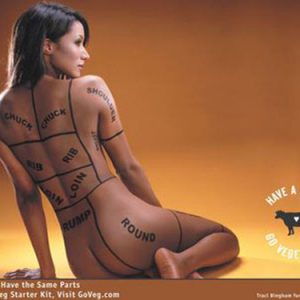
From billboards preying on insecurities about swimsuit season as a method of somehow saving whales to advertisements suggesting your real concern during airport body scans should be how hot your vegetarian body looks, the idea that PETA could still manage to shock anyone is worthy of a laugh. Or two. Though the artwork from ad to ad differs, the message is overwhelmingly the same: learn to respect the welfare of animals, while disrespecting that of people.

In other words, a porn site featuring juxtapositions of animal abuse images isn’t a new low; it’s exactly the type of half-baked tasteless trafficking that we should be expecting from PETA. As a countless number of galleries–including this one by Time magazine–highlight, PETA’s co-founder Ingrid Newkirk long ago made the conscientious choice that the best way to sell her message would be through exploiting women, and she does it because it works, sticking to her philosophy that PETA is obligated to serve as “press sluts” to bring attention to their cause.

And stick to it, she does. Newkirk is, after all, the same woman who famously wrote to Yasser Arafat, urging him to keep animals out of conflicts with Israel after a donkey died during a suicide bombing. No such request for the then-prime minister to condemn “honor killings” such as bride burning and female infanticide, which accounted for a full two-thirds of all killings within Palestine territories at the time, reflecting PETA’s less charitable view of women’s expendability in general.

Not to mention PETA’s emphasis that a woman’s value is strictly in how her body looks. Fat-phobia has been PETA’s old trusty in the arsenal long before the “Save the Whales” campaign. Ideally, PETA shouldn’t care what a body looks like, provided that the body is simply sustained by a vegetarian diet and vegan living. In actuality, they know that if there is anything our patriarchal society reviles more than women in general, it’s women of size, and preying on those cultural prejudices has been a source of great media attention, which normalizes the violence visited on those same bodies.

Of course, this cavalier dismissal of violence against humans (specifically, women) is the real problem with PETA’s approach to activism. In 2002, PETA filmed a would-be Super Bowl commercial, which depicted a group of hooligans beating a woman to death with a baseball bat to the caption of, “What if you were killed for your coat?” Though the commercial was banned from airing, just last year PETA turned up the heat (and the fake blood) to launch their “Meat is Murder” basics, placing humans in life-sized deli counter meat packages and cellophane. The gag might have been somewhat educational, if the models hadn’t looked as though they’d just come out of Jeffrey Dahmer’s freezer.

That joke might seem to be in bad taste (no pun intended) until you consider that the serial killer’s cannibalism has been the fodder of more than one advertisement and celebrity-targeted criticism. No, seriously. But Dahmer’s crimes aren’t the only ones that PETA finds acceptable to dovetail into their agenda. In 2008, PETA created an ad identical to their 1991 Dahmer special in response to the Manitoba Greyhound bus beheading, asking people to imagine the terror of victim Tim McLean and use it as motivation to “leave violence off of their dinner plates.”

However, the argument here isn’t that the decision to launch a porn website is continuing PETA’s legacy of playing up violence to make a point. Although feminists often disagree as to how empowering or violent pornography inherently is, what makes this particular venture par for the course is PETA’s decision to include images of animal torture. It’s a veritable buffet of -isms for the organization, with the unintended consequence of eroticizing the torture of animals.

Part of what makes PETA’s performance so frustrating is that they should know better. Their website contains a lengthy explanation about the correlation between people who abuse animals and violent behavior towards other human beings, suggesting that on some level, somebody in that organization should understand the intersectionality of subjugation for women and the animal kingdom.

More to the point, promoting misogyny—often, violent—with the end result of animal liberation makes about as much sense as using racism to end class politics. You’ll capture some headlines, but you’ll probably alienate more people than you galvanize, especially since people likely to be more sympathetic to animal causes tend to also be against the idea of exploiting women.

It goes without saying that there are plenty of reasons to care about the treatment of animals in this country and elsewhere. Any enlightened, progressive individual has to acknowledge that our experience is largely shaped by what we consume, and that includes consuming the animal community. But responsibility goes both ways, especially when we’re talking about oppression of marginalized classes like animals. For real change to happen, PETA has got to stop objectifying women to nothing more than literal pieces of meat.

* * *

Read other Adios Barbie content related to the eroticized violence of women:

A Monster Success! (reports on our successful petition against the official release of Kanye West’s misogynistic “Monster” video)

Deconstructing Kanye’s “Monster”


Post to Twitter

Five Surprising Ways to Love Your Body This Halloween

Image by Kyla Hollis

By Ashley-Michelle Papon

When I was a kid, before I understood that patriarchy wasn’t a particular type of game hen, Halloween was my favorite holiday. I spent weeks dreaming about my costume. In hindsight, this was a rather amusing waste of my time because I dressed up as a ballerina for six years straight. It’s worth mentioning, of course, that growing up in Kansas, I spent many Halloweens lacing my toe shoes over my snow pants as a way to stem off the cold while we trekked from door to door.

Maybe it was this early flirtation with clothing conservatism that kept me from seeing the value in the trend of Halloween costumes in recent years. In fact, I often feel like Lindsay Lohan’s character from “Mean Girls,” trying to dream up the most awesomely intricate character charade, only to be greeted by fellow femmes hanging out in lingerie and animal ear headbands.

With this kind of backdrop, is it any wonder Halloween seems to kick off the season of shame and insecurity? As women, we’re constantly bombarded with messages that we need to be all sex, all the time, something that has created a wide range of lasting impacts in our society from eating disorders to self-esteem issues. Culturally, women are taught that their overall sexiness defines their worth and identity. Even a night which has come to commercially bill itself as the one in which we can be anybody else offers only a conditional escape for women: they can be whomever they want to be, provided that person is still sexy.

This year, Halloween we get a much-needed make over in the self-esteem department from the Love Your Body Day campaign on October 19. Since 1998, the Love Your Body Day, an awareness effort by the National Organization of Women, has sought to get a dialogue going to speak out against advertisements and images of women that are harmful, disrespectful, and demeaning. These same words seem to be pretty appropriate descriptors for the Officer McNasty get-ups and sexualized storybook characters (I really don’t recall Dorothy wearing thigh highs, and remember, I’m from Kansas, so I’m totally an expert on all things “Wizard of Oz”).

Of course, swearing off the makeshift black cat backup costume is only a small step towards living the dream of body acceptance. Here are five surprising ways to use this fright night to celebrate and accept yourself—the scariest possible concept to companies that bank on people always hating what they see in the mirror.

1. Stage a costume contest that doesn’t include a category for the Sexiest Costume. Instead, honor the Most Comfortable Costume or Best Looking Costume That Escaped Conditioning for What Women Should Look Like but Really Don’t Because It’s Unhealthy. Similarly, good luck fitting that title on a plaque.

2. Listen to songs that preach loving every inch of yourself, regardless of what the magazines say. When you’re creating your party shuffle, make sure to sandwich songs like Christina Aguilera’s “Beautiful” and India.Arie’s “Video” between Halloween hits “Monster Mash” and “Thriller.” These tender tunes (and others) are a perfect anthem of acceptance.

3. Make a pinata based on snappy advertising lingo. Take a stack of magazines and pull out the pages that offer up advertisements promoting weight loss or exploiting women to sell a product. Use these strips of magazines to create your own Halloween pinata, because what will be most satisfying than smashing words like “THE NEW AND IMPROVED SKINNIER YOU” to pieces?

4. Bob for buzz words. This activist twist on the old favorite has partygoers attempting to remove apples from tubs of water, but each apple is carved with charged, body-shaming language like “THINspiration” or “Nothing tastes as good as thin feels.” Whoever collects the most gets to take the apples home to make into a pie of body-praising affirmative goodness.

5. Skip the usual monster and spooky fare to create a more positive pumpkin carving experience. Using medium to large-sized pumpkins, select a word that sums up loving your body. Decorate one side of the pumpkin around this word, carving and bedazzling it. Make it yours! On the other side, illuminate why this word applies to you.

Halloween is usually a holiday where we get to celebrate being someone, anyone else, for another day. This year, let’s focus on celebrating the opportunity to be ourselves.

This post is part of the 2011 Love Your Body Day Blog Carnival.

In Hollywood, Love Your Body Day is celebrated on Sunday October 23rd and Adios Barbie will be there! Co-founder/co-editor Pia Guerrero is leading a panel called “Beyond Beauty and Body Image” that’s not to be missed. For more information, visit NOW Hollywood’s website here.

Related Content:

Halloween is Frightening When it Sexualizes and Stereotypes

7 Ways to Love Your Body (Through Thick and Thin)

Post to Twitter

Two Steps Forward, One Step Back: Playboy, Porn, and Pole Dancing

TBD-NEWS-20-5-8-PLAYBOY2.jpg

By Sheena Vasani

“Would you rather have brains or beauty?”

“Beauty,” replies the Miss University London beauty pageant contestant adding because if she weren’t beautiful “nobody would want to listen to her anyway.”

Should we assume this quote came from newspaper archives, maybe from the 50s? Unfortunately not. The Guardian included this quote as part of a story reporting on the growing trend of UK university beauty pageants in December 2008.

Take a closer look and a disturbing pattern emerges.

The Guardian reported in 2006 that one of the UK’s leading retail groups WH Smith, reported its Playboy stationery line as one of its best-selling of all time. Ironically, its popularity lay not with boys, but adolescent girls. And while the BBC reports that WH Smith has since withdrawn these products, shops like Wet Seal in America still sell clothes promoting the Playboy bunny brand to teenage girls. Numerous large retail stores in both the UK and US sell inappropriate sexy clothing for children that many parents actually buy. Reports indicate the female public figure many American teenage girls look up to is Paris Hilton, well-known for her sex tape and rich father. And then I discovered that Brown University offers pole-dancing competitions, as does Cambridge University.

That’s right, folks. Forty years after feminism’s second wave burst onto the scene, 40 years after female activists burned bras, and 40 years AFTER Gloria Steinem went undercover as a Playboy Bunny to expose the misogyny involved in that world, women have gone from being viewed as sexual objects to – you guessed it! – still being perceived as sexual objects, whose only real accomplishment and source of power lies in their lust-provoking abilities.

Now, don’t get me wrong. The second wave was about empowering women, destroying the ideology running rampant stating a woman’s sole purpose was to sexually please men. In many, many respects, it succeeded. Women received more opportunities to shine than their mothers, particularly in the workplace. According to the U.S. Department of Labor data from 2009, women held “49.8 percent of all jobs, their highest proportion in history.”

But if a beauty pageant contestant from one of the best university systems in the world admits her looks are more important than her brain, if young girls feel the pressure to look sexy that they purchase the likes of pole dancing kits, what is this saying about female liberation and gender equality?

Sadly, some women are also encouraging such choices, celebrating it as “post-feminism.” As Christie Hefner, Playboy CEO and daughter to Playboy founder Hugh Hefner explains, “the post-women’s movement generation has just a more grown up, comfortable, natural attitude about sex and sexiness that is more in line with where guys were a couple of generations before.”[i]

So, the oppression of females through sexual means by men back then was not so much a human rights violation as it was actually a portrayal of male enlightenment, and now that we slow and insecure females understand this we are reverting back to objectifying ourselves?

I’m all for sexual expression and liberation, and if participating in pornography or pole dancing satisfies you, then fair enough. But the fact is many women involved in pornography describe their experiences as unfulfilling, as the famous memoirs of Traci Lords and Jenna Jameson show. Yes, Jameson might be quick to promote the pornography industry, but one has to wonder why she also says if she ever had a daughter, “she would lock her in the house before she’d let her get involved in the sex industry”?[ii]

Not to mention, many women are drawn to the adult entertainment industry out of financial or emotional problems, often resulting from sexual abuse. Both Traci Lords and Jameson’s personal stories speak of childhoods or teenage years filled with trauma. As Mary Anne Layden, Ph.D., and Director for Women’s Psychological Health in Philadelphia states:

“Most strippers, as with other women who work in the sex industry, are adult survivors of childhood sexual abuse. Research indicates the number is between 60%-80%. …Often as adults they reenact their childhood trauma by working as strippers, Playboy models, and prostitutes. The men who, now as customers, physically and visually invade the adult women’s bodies, reenact the role of the perpetrator. These women work in the sex industry because it feels like home.”

And what about the women who don’t work in the sex industry but want to associate themselves with Playboy and pole dancing? I don’t buy that this is genuine sexual liberation. It’s still about pleasing men.

Perhaps this happened because we grew overwhelmed with the impossibly hard to reach standards of beauty laid out for us by the images of airbrushed, artificially altered beauties? Perhaps we fell for the underlying message of ads flaunting such photos, that we are simply sex objects, who are only to be seen? Or maybe we just became tired of pointing out the objectification of women only to be dismissed, called prudes? Instead, we convinced ourselves life would just be “easier” if we repressed our anger and lived in denial? After all, who wants to be perceived as insecure and undesirable, especially to men? Whatever the reason, in an ironic move to feel “empowered” and wanted, instead of beating our oppressors, we are sadly joining them.

Next time you fantasize about being a Playboy bunny, feel pressured to visit a strip club even though you’re heterosexual, or to take up pole-dancing classes, remember the words of Susan Brownmiller, one of the most involved members of the real women’s liberation movement in the 70s: “You think you’re being brave, you think you’re being sexy, you think you’re transcending feminism. But that’s bullshit.”[iii]

Women of the West the battle still wages. Let’s join forces and get our acts together, lest we run the risk of selling out.


[i] Levy, Ariel. Female Chauvinist Pigs: Women and the Rise of Raunch Culture (London: Simon & Schuster, 2005) 39.

[ii] Levy, Ariel. Female Chauvinist Pigs: Women and the Rise of Raunch Culture (London: Simon & Schuster, 2005) 183.

[iii] Levy, Ariel. Female Chauvinist Pigs: Women and the Rise of Raunch Culture (London: Simon & Schuster, 2005) 82.


Post to Twitter

Help Expose the Real Illusionists

Illusionists

By Sharon Haywood, Co-Editor

“To men a man is but a mind. Who cares what face he carries or what he wears? But a woman’s body is the woman.” Filmmaker Elena Rossini cites this quote from writer Ambrose Bierce as her third reason out of 30 for creating The Illusionists, a full-length documentary about how the body has been transformed into the “finest” consumer object worldwide. As www.theillusionists.org explains, author Germaine Greer referred to women as illusionists “as they ‘fake the roses in their cheeks, the thickness, color and curliness of their hair, the tininess of their waists, the longness of their legs and the size and shape of their breasts.’” But the real illusionists—the beauty industry and mass media—are exposed in Rossini’s documentary as the culprits who unscrupulously sell unattainable beauty:

“They create, shape and maintain our shared beliefs, values, and rules, promoting aspirational ideals of female beauty that are very difficult – if not impossible – to achieve, in order to create new needs and apprehensions that fuel a 500 billion dollar industry.”

Rossini and her team have set up a fundraising campaign that needs your backing. They have chosen Kickstarter, an incredible online fundraising platform that provides creative projects the opportunity to reach out to like-minded folks like you for support. The ask? $33,000 in 43 days. At the time of writing this, $16,000 has been donated and 29 days remain. An amazing amount of money in two weeks. But Kickstarter has a catch—the project abides by an “all-or-nothing funding method.” In other words, if the project fails to reach 100% of its funding goal by August 5th, all pledges will be lost.

With footage from around the world, including Europe, the United States, India, and East Asia The Illusionists will present a truly global close-up at “how mass media, advertising and several industries manipulate people’s insecurities about their bodies for profit.” The film’s list of experts is impressive: Psychotherapist and author of 11 books, including Fat is a Feminist Issue and her latest, Bodies, Susie Orbach; author and filmmaker Jean Kilbourne, most recognized for her groundbreaking film series about women and advertising, Killing Us Softly; and the founder of Women in Media & News and author of Reality Bites Back, Jennifer Pozner. Plans are in the works to interview others, such as the famed writer and philosopher Umberto Eco and the controversial photographer, Oliviero Toscani well known for his multi-racial Benetton ads. What’s more the film will also include testimony from advertising executives, magazine editors, scientists, historians, and sociologists.

I can think of a few more solid reasons why we need to see The Illusionists: it will act as an invaluable educational resource “making viewers more empowered consumers of media,” provide people with a tool to help them reject the self-esteem crushing messages from marketers, and it might even act as a catalyst for change in how women are represented in the media. But none of that can happen without your support.  Rossini explains that,

“there is a lot of censorship surrounding these issues. Funding the film independently, through people’s donations, is the only way we can be completely candid about these topics, without interference from media companies.”

That’s where you come in. With only 29 days and $17,000 to go, Rossini and her team are relying on you. The last but definitely not the least important reason Rossini has chosen to make (and fund) The Illusionists is number 30 on her list: “Because I feel inspired by this quote by Margaret Mead: ‘A small group of thoughtful people could change the world. Indeed, it’s the only thing that ever has.’” Be part of the change. Extend your support and help the Illusionists team meet its goal. The repercussions are bound to be long lasting.

* * *

Visit The Illusionists Kickstarter campaign to make your pledge (which also comes with cool rewards like a DVD of film).

More about the filmmaker: Rossini’s previous work is outstanding. At just 25, she wrote, produced, and directed the full-feature narrative fiction film, Dove Sei Tu. She was also commissioned by the Louvre museum and ARTE Web to create the powerful short documentary, Ideal Beauty in which she compares and contrasts how beauty has been expressed via art with mass media’s current version of the physical ideal. More recently, notable projects include being the cinematographer for Three Days to See (director Garrett Zevgetis) and filming Lili’s Journey, in which she interviewed the Her Majesty Queen Rania of Jordan.


Related Content:

In the name of girls: The AMA calls for magazine ads to end photoshopping bodies


Post to Twitter

A Monster Success!

kanye-monster-video

By Sharon Haywood

It’s official folks, and you heard it here first: MTV and VH1 will not air Kanye West’s “Monster” video. Jeannie Kedas of MTV Networks, which also controls VH1, has recently confirmed that neither channel “has plans to air the video.” Kedas cited MTV’s voluntary standards department as a guiding force in their choice, but you can bet that our collective online movement against the official release of “Monster” also had something to do with MTV’s principled decision.

When I first watched the leaked clips of “Monster” I was so infuriated and disturbed that I couldn’t just say, “That’s an incredibly offensive and misogynistic music video. Wow, artists are really pushing the limits, aren’t they?” and get on with my day. In the past, there have been countless media messages that have riled me up, but never have I been so affected than after watching those unofficial clips for the first time. My stomach turned as I took in images of nearly naked dead women hanging from chains, a contorted dead woman splayed on a couch wearing nothing but red stilettos, and two dead woman propped up in bed being maneuvered like playthings by Kanye himself. Oh yeah, don’t forget Kanye gripping the hair of a woman’s severed head. I couldn’t just sit by and tweet how P O’ed I was. I’m so glad I didn’t.

In January, I paired up with author and activist Melinda Tankard Reist to create a petition targeted at MTV and Universal Music Group (UMG) to prevent the mass release of these misogynistic images being touted as art. With the support of the Coalition Against Trafficking in Women Australia, Collective Shout, Amanda Kloer of Change.org, Samer Rabadi of the Petition Site by Care2.com, and my colleague, co-editor/founder of Adios Barbie Pia Guerrero, we circulated two petitions, where we were met with your overwhelming support of over 21,000 signatures. In late February, as the number of signatures continued to climb, I communicated with Kedas who informed me that the network “would not air the current version,” a success that we shared on our Facebook page. MTV followed up shortly thereafter to clear away rumors of a “Monster” ban. They posted this statement on their website:

“The video was submitted to MTV, but it wasn’t banned; rather, edits were requested based on the channel’s decency standards.

MTV has not banned Kanye West’s ‘Monster’ video,” the network said in a statement to MTV News. “We have been in constant communication with the label regarding this matter. However, we are still awaiting the edits we requested in order for the video to be suitable for broadcast.”

So, we waited and continued to speak out against the use of eroticized violence as mainstream viewing. On June 5th, the official release of the long-awaited version of “Monster” appeared online. The only thing that was strikingly different from the leaked clips was the disclaimer at the beginning of the video: “The following content is in no way to be interpreted as misogynistic or negative towards any groups of people. It is an art piece and shall be taken as such.” It might as well have read: “Warning: The following content may cause physical and emotional upset such as nausea and seething anger” because the final cut still contained the same sexually violent images that sparked our activism in the first place. It’s obvious that the inclusion of a disclaimer tells us that someone at Def Jam, UMG, or even West himself is paying attention to our protest. Note to artists and producers: A disclaimer does not erase nor excuse misogynistic content.

We want to publicly acknowledge and applaud MTV Networks for choosing not to air “Monster.” We congratulate MTV for reinforcing the fact that violence against women, even if couched in a horror-film format, should never be used as a way to engage and entertain viewers, many of who are under the age of 18. We need you to let others know that MTV is acting as a leader by recognizing that eroticized violence in no way, shape, or form, is entertainment. (Here’s their Facebook page. Like ‘em.)

And what about UMG, the other target of our petitions? Despite my many attempts to procure an official statement, UMG has nothing to say on the record. Some may argue that UMG shouldn’t be held accountable, as the company is not responsible for the creation of West’s content; the artist’s own record company Def Jam assumes that role. Instead, UMG focuses solely on distribution (as is indicated in the copyright at the end of “Monster”). Thanks to MTV, there aren’t many distribution options left for the video. (Here’s MTV’s Twitter handle. Thank them personally. I have.)

It’s high time that media big guns, like UMG follow MTV’s lead and recognize that profits can still be gained by taking a socially responsible stand—not in spite of doing so, but because of it. As your support has shown, there are a growing number of consumers who give more than a damn about what choices are offered to them as entertainment. Corporate bigwigs need to also realize that our work is not yet done. Far from it. Our petitions did not target the music industry as a whole but instead we focused on a single video as taking one step toward positive change. As Change.org says,

“We believe that building momentum for social change globally means empowering citizen activists locally — and that the influence of a local victory is always much larger than the change it immediately achieves.”

The sum of many small victories means notable social change. We know that the video’s lack of distribution will not eliminate the presence of misogyny in the music industry. But at least we know we’re moving in the right direction. We’ve been heard. And we’re fairly sure that the music industry will continue to listen.

Stay tuned.

* * *

Related Content:

Read the text of our petition that was distributed by The Petition Site and Change.org.

Check out Pia Guerrero’s “Deconstructing Kanye’s ‘Monster’” published a week after our petition went live.

Samer Rabadi of The Petition Site interviews Sharon Haywood shortly after the petition launch.


Post to Twitter

Can Kharma Crush Stereotypes in Women’s Wrestling?

Kharma in the ring. Photo via www.ultimatesportstalk.com

Kharma in the ring. Photo via www.ultimatesportstalk.com

By Ashley-Michelle Papon

For as long as I’ve been playing the dating game, I’ve witnessed how wrestling (the fake kind) has a hold on the people of my generation. In fact, of all the people I’ve dated (or, in a select few cases, married) wrestling seems to be the only unifying thread. I had never understood the attraction to watching half-naked grown men pummel it out with story lines that obviously had been ripped from the mock-ups of “All My Children.”

My attitude changed somewhat after former star Mick Foley became an outspoken advocate for the Rape, Abuse, and Incest National Network. The actions of a man who made his career in an industry not exactly renowned for empowering women certainly caught my attention, both as a member of the RAINN Speaker’s Bureau and as an individual who would have preferred watching cat food commercials to the awkward Sparta-meets-Susan Lucci experiment that wrestling delivered. So, for the last year and a half, I’ve been tuning in, and taking notes.

What’s come across my clipboard this week is a wrestler by the name of Kia Stevens, who goes by Kharma, formerly known as Awesome Kong. Currently appearing on the Worldwide Wrestling Entertainment’s Raw brand, Kharma has been an active wrestler since 2002, even earning the number-one spot in Pro Wrestling Illustrated’s inaugural list of top 50 female wrestlers. She’s the largest woman to wrestle for the WWE, and she’s a woman of color. And, according to at least one WWE fanboy, Kharma was handpicked to begin her career with the WWE this month by the heir apparent to the empire, Triple H.

With all that in mind, I have just one question: how could the WWE be so close to getting it right (for once) and ultimately fail?

Obviously, the WWE doesn’t generally tend to be on board with advancing the agenda of women’s empowerment. One quick glance at the championship belt for the Diva’s brand, with its curlicue letters, shimmering rhinestones and butterfly-shaped emblem is all it takes to set some viewers back a century in their perception of women as athletes. And if that doesn’t seal the deal of sexism on screen, watching as women battle it out in the ring with pillows while screeching about the “disrespect” they’ve experienced probably will. Here’s a hint, Chairman McMahon: if you can’t tell the difference between your show and ‘Jerry Springer,’ neither can your audience.

This is also why Kharma’s inclusion into the WWE could turn the world of Diva wrestling on its ear. To begin with, Kharma’s attire reflects something very different. Kharma’s revolving line of costumes is seemingly channeling the wardrobe of some ancient culture’s warrior. Not exactly original, but a refreshing departure from the typical ware of bikinis and bondage straps favored by many of her peers, and it helps build on her gimmick (in wrestling lingo, ‘gimmick’ refers to the identity of a character and their basic back story) as this phenomenon from another culture. It forces the audience to pay attention to her behavior in the ring, versus getting lost in the flashes of bare skin across the screen.

Additionally, Kharma is a woman of color, something that was a rarity in the WWE until the last few years. But the real kicker is that Kharma is also a person of size. According to the WWE’s website, Kharma is almost six feet tall and nearly 300 pounds, the largest Diva ever on record.

It would be easy to conclude the article here with a paragraph praising Kharma’s feats and congratulating the WWE for joining the rest of us in the 21st century. But it isn’t that cut and dry, because the introduction of Kharma also highlights some of the most troubling aspects of race and sex that have long plagued the WWE.

In her three-week tenure as a WWE Diva so far, Kharma has chewed through half a dozen of her Diva peers. With the notable exception of Alicia Fox and Ever Torres, each Diva Kharma has destroyed in the ring is not identifiably of color.

The racial aesthetic can’t be ignored, particularly with how the matches have been executed. The visual is striking, and intentionally so: Kelly Kelly, with her gold lame wide-belted boy shorts and perfectly straight blonde hair, a shrinking violet to the large, menacing advance of the multi-braided Kharma. It doesn’t help that Kharma enters to a theme music composed of the sudden strike of a piano, and her own maniacal laughter against an electric guitar riff fit for a haunted house. The idea of the savage (Kong?) is complete.

Perhaps it’s a failure of the writers behind the WWE, who have given us stereotype after stereotype to disservice people of color. Whether it’s the duo of Cryme Tyme talking about boosting cars or Yoshi Tatsu appearing to speak in only broken English, the WWE continually exposes our worst perceptions and promotes them. As Daniel Douglass writes at Inside Pulse, the WWE remains unapologetically racist, questioning, “Why waste time with character shading and depth, when we can simply seize a ready trait, inflate it and hope to Christ they don’t notice they are cheering a cardboard cut-out?”

For women, the lack of character depth is part and parcel of being involved in wrestling. A year and a half ago, WWE fans witnessed as Mickie James, a spunky, bright-eyed Diva with real talent, got demoted to the Smackdown brand. Not long after, James was thrown into a Mean Girls-esque rivalry that left her re-christened ‘Piggie James’ and defending her (healthy) body size to her competing Divas, and the millions of WWE fans who tune in every week. As Kit MacFarlene concludes over at PopMatters, “The fact that it’s just about impossible to find a word to describe the not-extremely-thin Mickie that doesn’t essentially imply ‘fat’ says a lot about how far we haven’t come with cultural body image problems.”

The treatment of James also exemplifies why Kharma’s presence should be a welcome one to confront and shake up the notions of what makes a WWE Diva, and also hammers home why the limited performance of her character so far is a profound disappointment. It’s not as though the WWE is the first or even the worst offender in terms of the intersectional prejudices Kharma represents, but given that the WWE is showcasing women doing something that is traditionally a man’s activity, is it wholly unreasonable to expect more than what they’ve delivered so far?

No, it isn’t.

In order to create change within a faulty system, it is important to work within it. Kharma’s had a disappointing show so far, but it isn’t too late to turn around and portray Kharma as a woman who is intimidating because she’s one hell of an athlete, not because she happens to be a person of size and a person of color.

It goes without saying that wrestling is never going to be the hotbed of intellectual discourse, and that’s fine. We’re talking about a genre that banks on mixing comedic punch lines with impressive acts of athleticism—but for the minority voices in wrestling, we want to see them do more of the latter and stop being the former.

UPDATE June 10, 2011:

On May 30, the character of Kharma was dealt another blow when Stevens announced her real-life pregnancy. For the first time since the introduction of her character, fans were introduced to the voice that had previously been reduced to maniacal cackling while the mouth bit off the heads of Barbie dolls. With restrained passion and emotion, Stevens discussed her dreams of becoming a WWE superstar, only to be told by one of the largest names in the business that she was too fat to succeed.

Her poignant speech might have served as something of a wake-up call for the audience, but in characteristic WWE fashion, the surface-level enlightenment is immediately dismissed by the real men behind the curtain. Out pop Kharma’s earlier pummeled rivals, the Bella Twins, to deliver a hat trick distracting from social awareness.

In a 90-second promo, they make 10 individual references to Kharma being too fat to wrestle or to sleep with, concluding her partner must have had to use a seat belt. Although the send-off will serve to hold fans over for the duration of Stevens’ pregnancy, it’s nevertheless the same misogyny and warped body messages being rehashed to a character that might have risen above them otherwise.

Related content:

Lindsey Vonn Sports Illustrated Cover PICTURE: Photo Causes Controversy

Caster Semenya’s True Identity Is Up to Her

Post to Twitter

To BE or To Be Looked At?

Norman Rockwell's "Girl at the Mirror"

By Lexie Kite at BeautyRedefined.net; Cross-posted with permission.


Norman Rockwell's "Girl at the Mirror"

You are capable of much more than being looked at.

Have you thought about this statement? Do you understand the gravity of it? This was the first of the four messages Lindsay and I carefully chose for our billboard campaign going up in June, and it gave me goosebumps when I let it sink in. Women are always being looked at. And when we aren’t being looked at, we are too often envisioning ourselves being looked at, as if an outsider’s perspective has become our own. In fact, our work makes one thing very clear: Part of growing up female today means learning to view oneself from another’s gaze.

Ever heard this quote? Men act and women appear. Men look at women. Women watch themselves being looked at. This determines not only most relations between men and women but also the relation of women to themselves. The surveyor of woman in herself is male: the surveyed female. Thus she turns herself into an object—and most particularly an object of vision: a sight. (John Berger, Ways of Seeing, 1977).

This insightful man was referring to the idea of “objectification,” which we’ve all heard once or twice. But when we think of the term, we probably think of sexualized female bodies, or sexualized parts of female bodies…which isn’t the whole idea here. When we understand the whole of objectification, we can better grasp the role it plays in our daily lives and the ways it may keep us from fulfilling all we want to do with our days. When we travel around giving our one-hour Beauty Redefined visual presentation, we explain to our audiences that objectification takes on many roles:

Say you’re walking down the sidewalk on a beautiful day. Someone who has internalized an outsider’s perspective of herself will often spend more time adjusting her clothing or hair, wondering what other people are thinking of her, judging the shape of her shadow or reflection in a window, etc. She will picture herself walking – she literally turns herself into an object of vision – instead of enjoying the sunny weather, looking around, thinking about anything else, etc. If you find yourself the victim of this type of activity, you aren’t alone. In fact, you are just one of millions of females growing up in a world that teaches us to survey ourselves every waking moment. Profit-driven media tells us how we can “Look Hotter From Behind!” in fitness magazines, “Look Wow Now!” on makeover shows every hour of every day, “Look 10 Years Younger!” using every anti-aging procedure and product under the sun. Notice the emphasis on looking…Do you find you survey yourself as you move through life? That you ever turn yourself into an object of vision: a sight?

You are capable of much more than being looked at. Do you know who you are? Have you grasped the powerful role you can play in a world so badly in need of your unique talents, wisdom, and light? Are you aware of your unique mission at this point in your life? You’ve got something great to do, that only you can do. And if you are here to be looked at, to appear, to survey yourself instead of do an inspirational work that only you can do, you are not fulfilling your mission. Cheesy? Yes. True? Oh yes. More true than you know.

I see objectification playing out in my own life in many ways. Here are two: When I’m walking past people, I always imagine what I look like to them – from the front and from behind – and think irrational thoughts about what the people walking behind me or past me think about me. I often adjust my clothing to what I assume is the most flattering position as I walk. I can admit I’ve been known to look at my own Facebook profile to see what I look like to the cute guy who just added me or the friend I just added. I look through my photos and try to gauge my looks from the perspective of someone who is not me. If that isn’t self objectification, I don’t know what is! Tell me I’m not alone in doing this…?  I am a body image activist and I’m getting a Ph.D. in research on self-objectification, yet I still spend time envisioning myself from an outsider’s perspective instead of moving on to so many things more meaningful and productive. This just goes to show it’s a constant battle. I am constantly working to remind myself I’m capable of much more than being looked at. My self-objectification is complicated by the fact that I am an identical twin, so in some ways I see a body of a person with identical DNA in real life in a way that most people cannot experience. Unless you have an identical counterpart, your vision of yourself comes from photos, videos, and your two-dimensional reflection.

So let’s talk about mirrors, shall we? Even as I sit in my bedroom typing at 2 a.m., I see a full-length mirror peeking through the closet door, one with hooks hanging all my jewelry, five small decorative mirrors, and an IKEA centerpiece mirror above my bed. While I don’t think I’m necessarily vain or image-obsessed, I spend 45 minutes in front of the mirror every morning, keep a compact in my purse at all times, and apparently have about 100 in my room for safe keeping. I am surveying an image of myself for at least one of the 24 hours in my day, and imagining that image of myself as I move throughout my day. What role do mirrors play in your life? “Women are constantly being looked at. Even when we’re not, we’re so hyperaware of the possibility of being looked at that it can rule even our most private lives. Including in front of our mirrors, alone,” says Autumn Whitfield-Madrano at her always inspirational website, The Beheld.

The thought-provoking Autumn is currently undergoing an experiment which I cannot deny reflecting upon: A month-long break from mirrors. Thirty-one days of no mirrors, store windows, shiny pots, spoons, or the dark glass of the NYC subway she rides daily. In her own words: There’s nothing wrong with looking in the mirror. There’s nothing wrong with sometimes looking to your reflection—even when it is impossibly subjective, and backward at that—for a breath of fortitude, centeredness, and assurance. I just want to see what life is like when I’m not using that image as my anchor; I want to see how it affects the way I move through the world, the way I regard myself and others. I want to know what it’s like to sever a primary tie to one of my greatest personal flaws—extraordinary self-consciousness—and I want to discover what will fill the space that the mirror has occupied until now.

She goes on:  Sometimes I look in the mirror and see myself, or whatever I understand myself to be. Other times, I distinctly see an image of myself. When I see my image reflected on a mirror behind a bar I think, Oh good, I look like a woman who is having a good time out with friends. Or I’ll see my reflection in a darkened windowpane, hunched over my computer with a pencil twirled through my upswept hair, and I’ll think, My, don’t I look like a writer? You’ll notice what these have in common: My thoughts upon seeing my reflection are both self-centered and distant. I’m seeing myself, but not really—I’m seeing a woman who looks like she’s having a good time, or a writer, etc.

Autumn’s insights echo Berger’s powerful words. Too often, we travel through life with an outsider’s vision of ourselves. We are to be looked at. We watch ourselves being looked at. We become objects of vision: sights. But isn’t there so much more to life than watching ourselves self-consciously stroll through it? Life is beautiful when you live it – really experience it – not when you are more concerned about appearing beautiful as you try to live. When you think of your happiest times, were they in front of the mirror? Were you happiest when you were working to appear happy or attractive or beautiful to others? Happiness and beauty come from doing, acting, being – outside the confines of being looked at. So, today, what will you do to shake off the outsider’s gaze you envision of yourself? Will you do as Autumn has done and experiment with what your life becomes when you spend less time with your reflection and more time doing, acting, and being? Will you enjoy the world around you instead of hoping others are enjoying their view of you? Will you do something your self-policing outsider’s gaze kept you from doing before – like speak in front of a group of people? Run without worrying about the jiggle? Go to the store without your makeup on?

Today is the day to remember you are capable of much more than being looked at. And when you begin to realize that, you can start realizing the power of your abilities and the good you can do in a world so desperately in need of you. NOT a vision of you, but ALL of you.  What will you find you are capable of?

Post to Twitter

Boobies, Ta-tas, and Cha-Chas, Oh My! The Sexy-fication of Cancer

Save+the+Tatas+Logo

By Sayantani DasGupta

“Save the Boobies!  I  ♥ Ta-tas! Save Second Base!”

Like the ubiquitousness of Lance Armstrong’s Live Strong armbands and Susan G. Komen Foundation’s pink ribbon festooned campaigns, “I heart the boobie” bracelets seem to be everywhere these days. Such as on the arms of young women showing their breast cancer awareness — and potentially getting kicked out of school for doing so. (Luckily, we have a little thing called the first amendment that applies, shockingly, even to high schoolers.)

Okay, we get it. We all heart the cha-chas. From Victoria’s Secret push-ups to plastic surgery obsessions and Girls Gone Wild type television, mainstream culture is hugely obsessed with breasts. (Unless you’re a mother trying to breastfeed your hungry infant with them, but that’s another blog post.)

Just recently, I read a fantastic critique of this sort of cutsie ‘Save the Ta-Ta’ campaign by Peggy Orenstein, who says,

Kittenish cancer campaigns… [are] simultaneously pathologizing and fetishizing women’s breasts at the expense of the bodies, hearts and minds attached to them. In that way, they actually suppress discussion of real cancer, rendering its sufferers — those of us whom all this is supposed to be for — invisible. I mean, really, forget “Save the Ta-Tas.” How about save the woman? How about “I ♥ My 72-Year-Old One-Boobied Granny?” After all, statistically, that’s whose rack is truly at risk.

Cancer campaigns have come a long way baby, from the decades when we whispered about “The C Word,” when physicians consulted husbands but left wives in the dark, when women entered operating rooms for simple biopsies and woke up without breasts. These were days when prostheses (and later, reconstructive surgeries) were framed as important, not for a woman’s self concept regarding her own body, but her desirability to her partner, as well as the general comfort of a society who did not want to be reminded of its own vulnerability to disease and disability by the presence of one-breasted (or no-breasted) women.

But women pushed back against these silencing forces by speaking up, and in that speaking, collectivizing.

Audre Lorde’s 1980 The Cancer Journals, not only gave voice to the “Black lesbian feminist” experience of breast cancer, but challenged women to “[transform] silence into language and action.”

In 1993, model and photographer Matuschka made the cover of New York Times Magazine. Her self-referential work, Beauty Out of Damage, placed her one breasted body in the public gaze and challenged us to see it as beautiful.

In 1998, a collection called Art, Rage, Us: Art and Writing By Women With Breast Cancer made space not only for creativity but for protest and anger in documenting the cancer experience.

Yet, such formulations have been replaced with a modern-day sex kittenish sensibility around cancer. A sensibility which is, yes, irreverent, fun, and accessible – but is also disturbingly connected to consumption. Forget marching, protesting, or lobbying – now a-days, we can “shop for the cure.”

In her critique of “cancer culture,” with its ubiquitous products, including pink-ribboned teddy bears, Barbara Ehrenreich writes,

If you can’t run, bike, or climb a mountain for the cure – all of which endeavors are routine beneficiaries of corporate sponsorship – you can always purchase one of the many products… The ultrafeminine theme of the breast-cancer “marketplace” – the prominence, for example, of cosmetics and jewelry – could be understood as a response to the treatments’ disastrous effects on one’s looks. But the infantilizing trope is a little harder to account for, and teddy bears are not its only manifestation… Certainly men diagnosed with prostate cancer do not receive gifts of Matchbox cars.

“Sexy cancer” stories such as Kris Carr’s documentary and book Crazy Sexy Cancer or Marissa Acocella Marcetto’s Manolo Blahnik-filled graphic memoir, Cancer Vixen create space for younger women and inject some much needed humor into cancer advocacy. Yet, like the Lance Armstrong’s Live Strong campaign, they potentially embody what writer Chimamanda Adiche has called “the danger of the singular story;” a story which promotes one sort of feel good, non-threatening-to-the-status quo narrative while silencing another.

Recently, an adult graduate student of mine wept as she recalled her experience with the “Look good, feel better” campaign as she was undergoing breast cancer treatment. The experience of walking into a room filled with garish, donated, “last season’s leftover” cosmetics and being condescendingly instructed how to use them only reinforced the notion that the way she looked and felt were socially unacceptable. This is not to say that such campaigns aren’t a source of support for some people. However, the danger is when such stories negate other messier and less socially palatable narratives of anger, such as frustration with the medical system, or people who are in fact dying from, rather than “winning the war against” cancer.

Sex-kitten narratives of consumption and cutsie-ness diminish the power of women’s activism around illness as much as historical silences. This is not to say that posting our bra color as our Facebook status or buying a bracelet for breast cancer is bad, rather, that it’s energy (and money) that could potentially be used more effectively – from organizing (as Orenstein suggests) dinners or childcare for women in one’s community undergoing cancer treatment, to investigating the links between environmental pollutants and the very corporations which sponsor pink-ribboned races for the cure.

Let’s not blindly shop and adorn ourselves to support corporate agendas. Let’s not allow a bracelet, or a dress, or a teddy bear, to silence the voices of women collecting in protest and social critique.

Ta-tas are sexy, sure. But sexier still are women’s voices and bodies in all their strength and diversity.

Related Content:

Save Your Boobs, Unless They’re Saggy

Conversations About Body Image: A Place At The Table For Me?


Post to Twitter

Prevent Official Release of Kanye West’s Women-Hating Video

42080-16x9-340x191
Kanye West in bed with two dead women

Kanye West in bed with two dead women

HipHopConnection.com has leaked a video teaser for the Kanye West hit song “Monster” and what we’ve seen is beyond disturbing. In just 30 seconds, viewers take in image after image of eroticized violence against women:

  • Dead women, clad in lingerie, hang by chains around their necks
  • West makes sexual moves toward dead or drugged women propped up in a bed
  • A naked dead or drugged woman lays sprawled on a sofa
Rick Ross sits in view of a dead/drugged woman & a plate of raw meat

Rick Ross sits in view of a dead/drugged woman & a plate of raw meat

If that’s not enough, a behind-the-scenes clip of the video includes a semi-naked dead woman laying spread eagled on a table in front of Rick Ross as he eats a plate of raw meat. It is likely we can expect more brutal images in the full-length video.

The victims in this video are clearly women. Only women. And the men, Kanye West, Rick Ross, and Jay-Z are far from bothered by the female corpses. They seem to enjoy being surrounded by lifeless female bodies, apparent victims of a serial killing.

The official release date of the full-length video has not yet been announced. Let’s make it clear to Universal Music Group, the controlling company of West’s record label, Roc-A-Fella Records, and MTV that the music industry’s portrayals of women’s pain, suffering, abuse, objectification, and victimization as valid forms of entertainment are not acceptable.

Dead women hang by chains

Dead women hang by chains

We call on Universal Music Group and MTV to combat violence against women by refusing to support, promote, and/or give airtime to West’s “Monster” video.

We call on you to support our efforts in preventing the official release of this disturbing and hateful video. In conjunction with Coalition Against Trafficking in Women (Australia)Collective Shout: for a world free of sexploitation, and Melinda Tankard Reist who brought this issue into the light, we have created a petition to block the video’s official release.

Please take a moment and sign the petition, which will be sent to Doug Morris, the CEO/Chairman of Universal Music Group  and Judy McGrath, the CEO of MTV.

And don’t forget to spread the word that our world has absolutely no room for this monstrous video.

Visit Care2 Petition Site to sign the petition.

Editor’s Note: As of June, 2011 we closed our petition in the name of success! MTV Networks confirmed with Adios Barbie that both MTV and VH1 will not air “Monster.” Read the full story at A Monster Success!


Post to Twitter

The Hijab: Can it Promote a Healthy Self Image?

Photo provided by www.SheilaSmartPhotography.com.au

Photo provided by www.SheilaSmartPhotography.com.au

By Sharon Haywood

Several years ago while traveling through Malaysia, I had the opportunity to visit a mosque in Kuala Lumpur, the country’s capital. Despite my modest dress (a long flowing skirt and a loose-fitting blouse that covered my arms), the mosque required that I wear an abaya, a cloak that covered my head, face, and all my clothing. (They had plenty on hand for tourists just like myself.) As I explored the mosque, I couldn’t move past the unsettling sensation of feeling invisible. From my western perspective, I had a difficult time imagining choosing to cover myself on a daily basis, as so many Muslim women do.

Recently, I came across Zofeen Ebrahim’s article, “Educated, Glamorous and Wearing a Hijab,” which got me thinking about head and body coverings from a body image perspective. I was left with two persistent thoughts. First, I’ve been contemplating the idea that by wearing a hijab, women are free from being objectified. Or least freer than women who do not don the Muslim headdress. Ebrahim quotes Farahnaz Moazzam who chooses to cover herself as saying: “I don’t feel like a product or an object anymore. Now people notice my smile, my conversation, and take me more seriously.”

The author echoes her sentiments:

“Aside from considering it as an offering to Allah, the women say dressing the way they do liberates them from worries about their looks and allows them – and other people – to concentrate on more important things.”

Second, I was struck by the concept of getting a funky hairdo, adorning my body with jewelry, and wearing clothing that reflects my fashion preferences only to keep it hidden from others:

“Fashion, why not?” says Moazzam. “I am as normal as any other woman. I have, however, come to a point where I am covering up my fashion statement, jewellery, haircut, in front of the crowd. But I still do it and enjoy it.”

How many of us dress just for ourselves? How many of us judge others based on their sense of style or size? I’m not suggesting that we should adopt Muslim customs such as the hijab or abaya, but I can’t help but wonder if we all covered up (men and women alike) how much more accepting we would be of others and ourselves?

Continue contemplating the hijab and body image and check out IPS Gender Wire to read Zofeen Ebrahim’s article, “Educated, Glamorous and Wearing a Hijab

Many thanks to Sheila Smart for permission to share the above photo.

Related Content:

All-American Muslim: A New Show Unveils Muslim Life in the Midwest

Post to Twitter